Cupid Flower Font: A Playful, Handmade-Ready Display Typeface
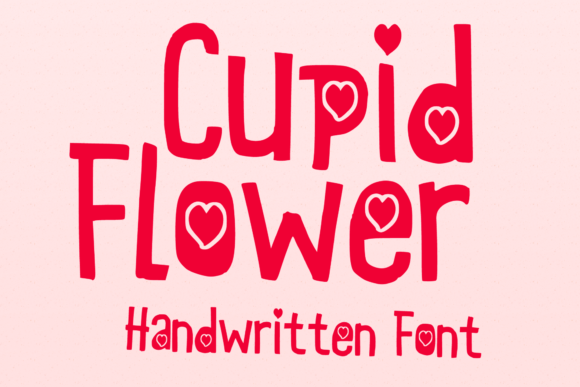
As a maker who designs printable invitations, laser-cut wooden signs, and boutique product labels, I’m always hunting for fonts that do more than just look pretty—they need to work. Cupid Flower is one of those rare display fonts that balances charm with clarity, warmth with wearability. It’s not overly ornate, but it’s never plain. Think soft curves, gentle bounce, and just enough personality to feel handmade—without sacrificing legibility on a 1-inch sticker or a heat-pressed tote bag.
Cupid Flower lives in the sweet spot between script and display: it’s casual enough for kids’ book covers and playful enough for Valentine’s Day greeting cards, yet structured enough to hold up on packaging labels, candle jars, and storefront signage. The letterforms have subtle contrast—rounded terminals, open counters, and friendly spacing—that makes it highly readable even at small sizes (I’ve tested it down to 8pt on printed tags with zero squinting). And because it’s designed as a display font—not body text—it shines brightest when used for short, high-impact phrases: “Love You More,” “Hand-Poured,” “Made With Heart,” or even single words like “Joy” or “Snuggle.”
Where Cupid Flower Fits Into Your Making Routine
You’ll reach for Cupid Flower most often when you need emotional resonance without visual noise. Here’s how it lands across real projects:
- Greeting cards & invitations: Use it for headlines and names—pair it with a clean sans serif (like Montserrat or Poppins) for dates, addresses, and details. The contrast feels intentional, not chaotic.
- Stickers & die-cut labels: Works beautifully in Cricut Design Space and Silhouette Studio. Its generous x-height and consistent stroke weight cut cleanly—even on vinyl or kraft paper. No fragile serifs to snap off during weeding.
- Product packaging: I use Cupid Flower on lavender-scented soap labels and mini jam jars. It adds artisanal warmth without looking dated or overly cutesy—a big win for modern cottagecore or minimalist-boutique branding.
- Wall art & printable decor: Print it large on matte cardstock for nursery art (“Little Love”) or frameable quotes. Its rhythm flows naturally across lines, and the slight irregularity in baseline alignment gives it handmade authenticity.
- T-shirts & totes: Screen-printers and DTG users love how Cupid Flower holds ink well. No thin hairlines to drop out, no tight kerning that bleeds together at scale.
Pairing Cupid Flower Thoughtfully
Because Cupid Flower leans expressive but stays grounded, it pairs effortlessly with typefaces that offer structure. Try it with:
- A neutral sans serif (like Inter or Lato) for balance—ideal for business cards, shop banners, or digital templates where clarity matters most.
- A light serif (such as Cormorant Garamond or Playfair Display) for wedding stationery or luxury packaging—Cupid Flower becomes the romantic accent; the serif handles elegance and hierarchy.
- A monoline handwritten font (not overly bouncy) for layered SVG designs—say, Cupid Flower for the main phrase and a simpler script for a tagline or date.
Avoid pairing it with other high-contrast scripts or ultra-thin display fonts—they compete instead of complement. Cupid Flower doesn’t need backup singers; it needs a steady rhythm section.
Practical Notes for Sellers & Creators
Cupid Flower comes in standard OTF and TTF formats—fully compatible with Canva, Adobe Creative Cloud, Affinity apps, and cutting machine software. There are no ligatures or swashes included, which I actually appreciate: it keeps file prep simple and ensures consistency across mockups and physical outputs. No surprises when your “Valentine’s” preview looks different from your final print.
It supports basic Latin characters (A–Z, numerals, common punctuation), so it’s perfect for English-language product labels, social media graphics, and Etsy listing banners—but double-check if you plan to expand into multilingual markets. For now, it’s a focused, reliable tool—not an all-language powerhouse.
And yes—this is a commercial font. You’re fully licensed to use Cupid Flower in physical products you sell (t-shirts, mugs, stickers), digital downloads (planner pages, invitation suites), SVG files for crafters, and client design work. Just remember: you can’t resell the font file itself or include it in a font bundle. That said, embedding it in a PDF template or converting it to outlines for an SVG? Totally fine—and something I do weekly.
Why Cupid Flower Stands Out in a Crowded Font Market
So many Valentine’s fonts scream “romance” with excessive swirls, dripping hearts, or cartoonish exaggeration. Cupid Flower sidesteps that. It feels sincere—not performative. When customers see it on your candle label or baby shower invite, they don’t think “generic holiday font.” They think “this person put care into every detail.” That perception translates directly to perceived value, repeat purchases, and word-of-mouth trust.
It also scales gracefully. Whether you’re designing a 4x6 printable or a 24x36 poster, Cupid Flower maintains its voice. No awkward stretching, no lost nuance. And because it’s built for display use—not long paragraphs—you won’t be tempted to misuse it where readability suffers. Respect the font’s intent, and it rewards you with polish.
If you’re building a cohesive brand identity around handmade warmth, seasonal charm, or heartfelt simplicity, Cupid Flower isn’t just another download. It’s a quiet collaborator—one that helps your products speak with sincerity, stand out on crowded shelves, and land softly in someone’s heart.